6 Powerful AI Coaching Marketing Analytics Software Tools to Scale Campaign Performance
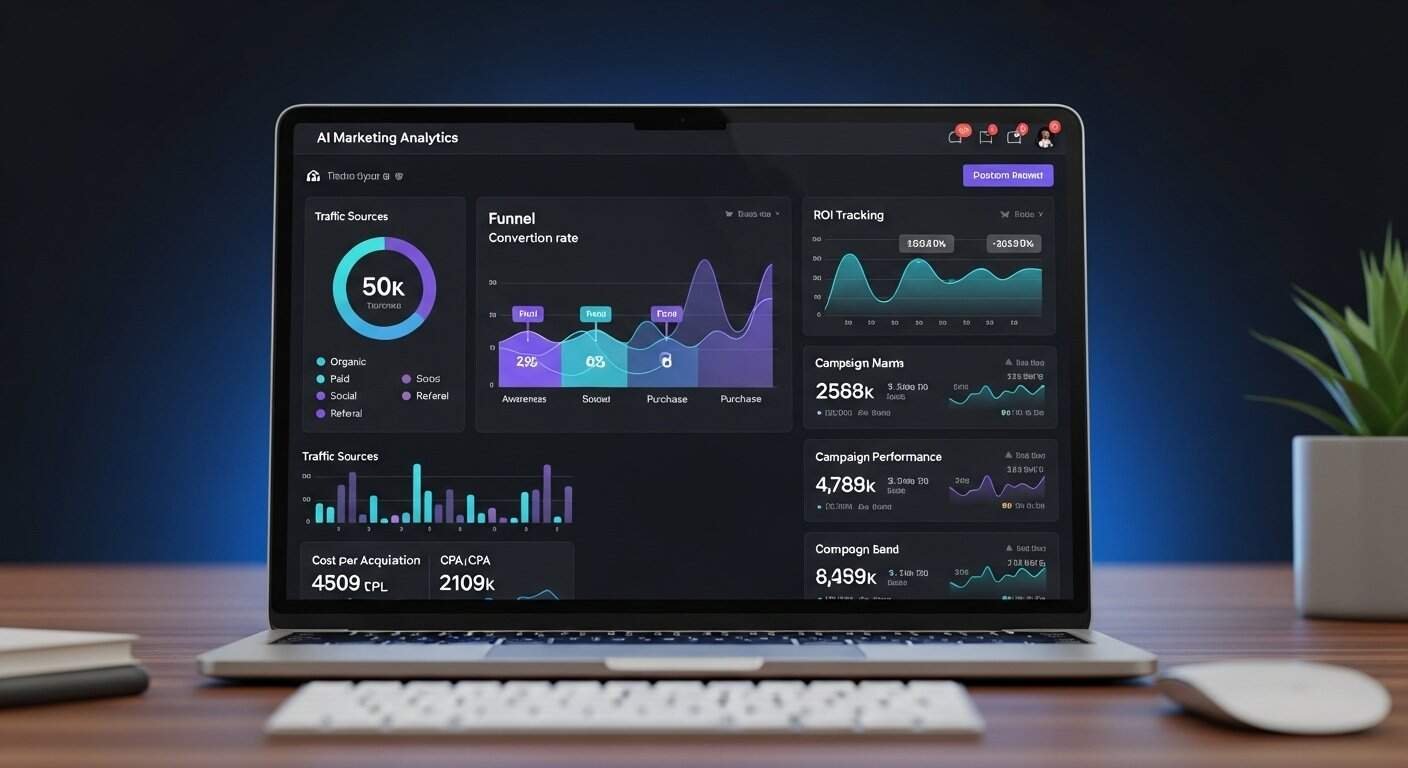
AI coaching marketing analytics software helps coaching businesses track campaign performance, analyze funnel conversion rates, measure cost per lead, monitor traffic sources, and understand which marketing activities actually produce profitable growth.
Many coaching businesses invest heavily in marketing without having a reliable system for measuring results. They run paid ads, publish content, build funnels, send emails, host webinars, and test offers. Activity is high, but visibility is low. The result is a common business problem: marketing effort increases, yet decision quality does not.
A coach may know that leads are coming in, but not know which traffic sources are producing the strongest leads. They may know that a funnel is generating sign-ups, but not know where the biggest drop-off occurs. They may spend money on campaigns, but not know which one is creating the best return. They may launch multiple promotions, but still lack clarity on cost per lead, conversion performance, or campaign-level ROI.
This creates operational inefficiency.
Without structured analytics, coaching businesses often make marketing decisions based on assumptions rather than data. Campaigns keep running because they feel active, not because they are profitable. Offers are promoted without a clear understanding of which channels support conversion best. Budget gets allocated based on intuition rather than measurable performance.
That is where ai coaching marketing analytics software becomes essential.
Instead of treating marketing as a collection of isolated actions, these platforms turn marketing into a measurable system. They consolidate campaign data, traffic patterns, funnel performance, conversion behavior, and ROI indicators into one structured analytics layer.
This helps coaching businesses answer practical questions such as:
- Which traffic sources produce the best leads?
- Which campaigns generate the strongest conversion rates?
- What is the actual cost per lead by channel?
- Which funnels are leaking prospects?
- Which campaigns should be scaled, paused, or improved?
When these questions are answered clearly, marketing becomes easier to optimize.
For coaches building a broader operating system, marketing analytics is only one layer of the full stack. A wider view of the ecosystem can be found in AI tools for coaches and consultants.
Core Features of This Software
The value of marketing analytics software comes from the quality of the capabilities it brings into the decision process. Good tools do not just collect data. They organize it into business-relevant insights.
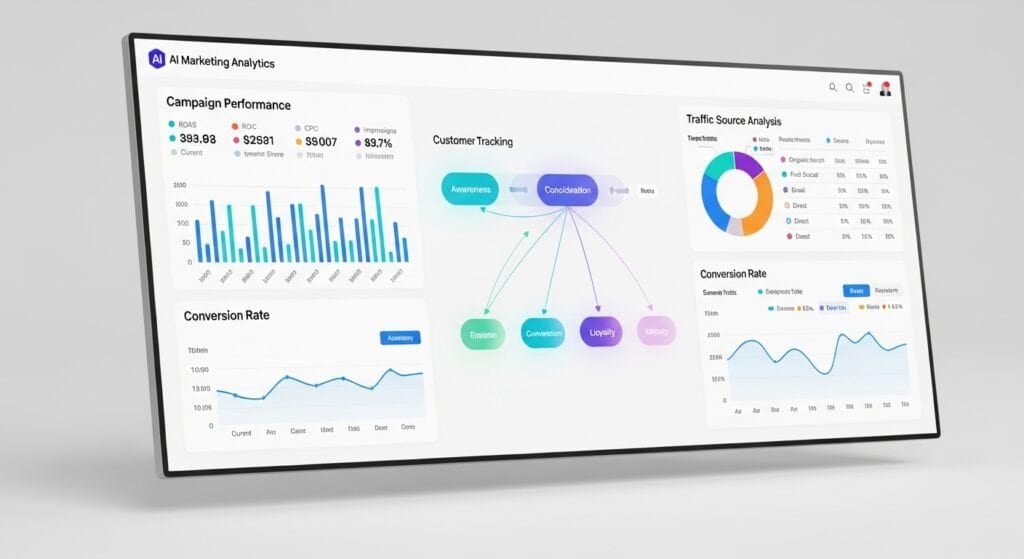
Campaign performance tracking
One of the most important core features is campaign performance tracking.
Coaching businesses often market through multiple channels at the same time, including:
- social media campaigns
- paid ad campaigns
- email campaigns
- webinar promotions
- content funnels
- landing page campaigns
Without analytics software, campaign performance may be spread across several tools. One platform shows ad clicks. Another shows email open rates. Another shows page visits. Another shows purchases. The business owner has to connect the dots manually.
Marketing analytics software solves this by bringing campaign-level metrics together in one place. This allows coaches to compare campaign outcomes directly instead of jumping between platforms.
Funnel conversion tracking
Most coaching businesses rely on some version of a funnel, even if they do not call it that.
A typical flow might look like this:
- traffic source
- landing page
- lead magnet opt-in
- nurture email sequence
- webinar or consultation booking
- offer presentation
- purchase
At every step, prospects can progress or drop off.
AI marketing analytics software makes funnel performance measurable. It helps coaches see:
- how many visitors enter the funnel
- how many become leads
- how many book calls
- how many convert into clients
- where drop-off becomes highest
This matters because a coaching business may not have a traffic problem at all. It may have a middle-of-funnel problem, a booking problem, or an offer-conversion problem.
For businesses focused on improving funnel efficiency, these systems often work well alongside ai funnel optimization tools for coaches.
Traffic source visibility
Traffic source analysis is another foundational feature.
A coaching business may be generating leads from:
- organic search
- YouTube
- Facebook Ads
- Google Ads
- referrals
- partner traffic
Without visibility into traffic sources, businesses tend to overvalue channels that feel busy and undervalue channels that actually convert.
Good analytics software shows not just where traffic comes from, but how traffic quality differs by source. This is a major distinction. A source that generates high traffic but poor conversion may be less valuable than a smaller source that converts consistently.
Cost per lead analysis
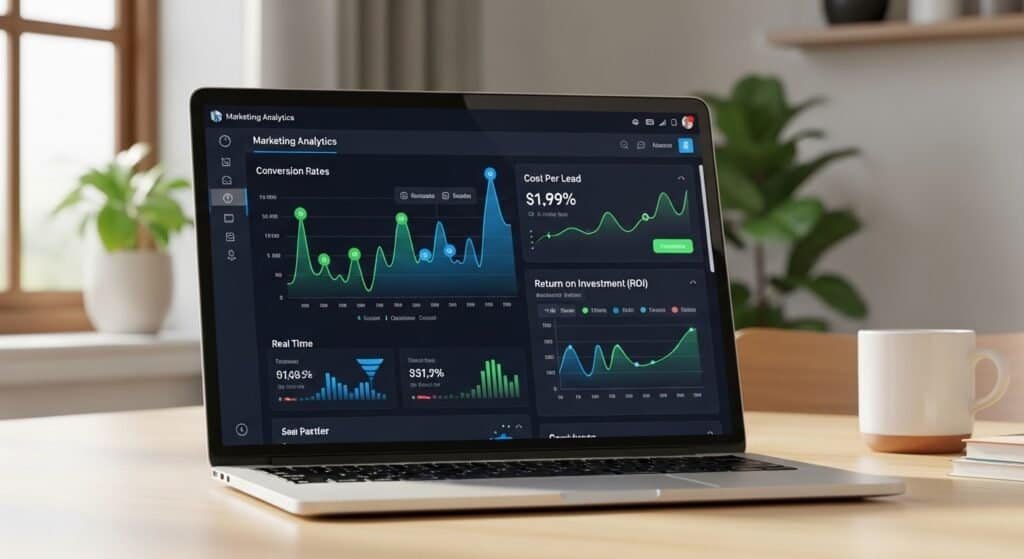
Cost per lead is one of the most useful metrics in coaching marketing, especially for paid acquisition.
If a coach is spending money on ads, they need to know:
- cost per click
- cost per lead
- cost per booked call
- cost per acquisition
Without cost-per-lead visibility, spend decisions are weak.
Analytics software helps calculate these values accurately across campaigns and channels. That allows coaches to identify where acquisition is efficient and where it is becoming too expensive.
ROI tracking
The most important financial marketing metric is return on investment.
Marketing analytics platforms help connect spend with outcomes. Instead of asking whether a campaign generated clicks or engagement, the better question becomes whether that campaign produced real business value.
ROI tracking makes this visible by relating:
- campaign spend
- lead generation
- conversion behavior
- client acquisition outcomes
That is what moves marketing from activity tracking to business tracking.
Advanced Capabilities Businesses Need
Core features are necessary, but not enough. As a coaching business grows, more advanced capabilities become important.
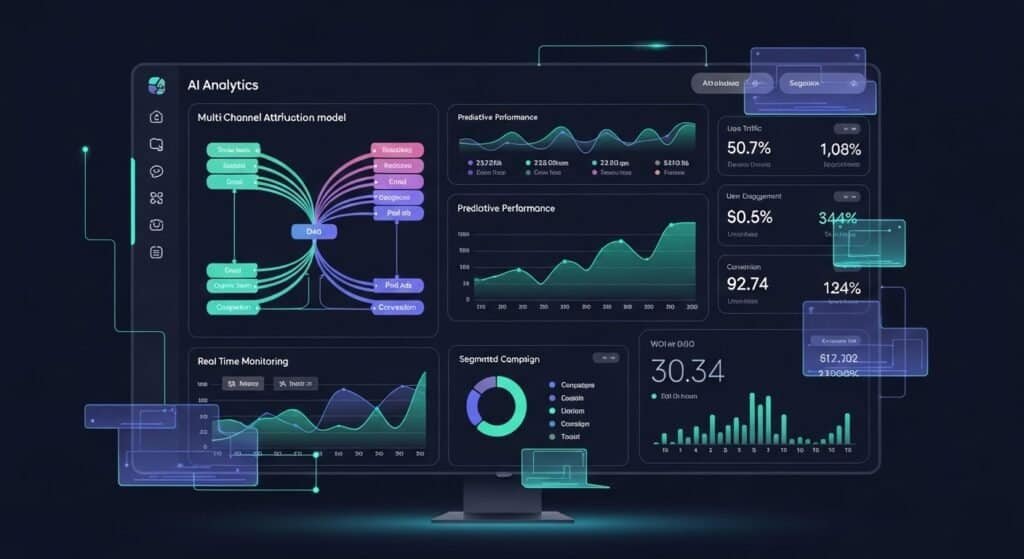
Multi-channel performance analysis
Most prospects do not convert after one touchpoint. They may discover the coach on one platform, return later from another source, join an email list, attend a webinar, and then convert days or weeks later.
This means channel performance should not be viewed in isolation.
Advanced analytics tools help businesses understand how channels work together. They reveal how awareness channels, nurture channels, and conversion channels combine across the buyer path.
This matters because businesses often cut channels too early when they only measure last-click outcomes.
Segmented conversion analysis
Not all leads behave the same way.
Some businesses need to segment performance by:
- offer type
- audience segment
- lead source
- campaign angle
- landing page version
- geographic market
Segmentation reveals whether performance varies across meaningful business categories. This is especially useful for coaches selling multiple offers or speaking to multiple audience types.
Real-time campaign monitoring
Campaigns can underperform quickly. Delayed reporting slows down decision-making.
Real-time monitoring allows businesses to see performance as campaigns run, which helps with:
- catching underperformance early
- adjusting spend faster
- spotting conversion drops
- monitoring launch windows
- reacting to sudden CPL changes
For coaches running launch-based promotions or paid webinars, real-time monitoring is highly useful.
Trend analysis over time
Single campaign snapshots are useful, but trend analysis is often more valuable.
Advanced tools help answer questions like:
- Are conversion rates improving month over month?
- Is cost per lead rising over time?
- Which traffic sources are becoming less effective?
- Are some campaigns decaying after repeated use?
Trend analysis supports smarter planning and prevents short-term interpretation errors.
Automated reporting
Coaches and small teams do not need more reporting work. They need less.
Automated reporting lets the business receive consistent performance summaries without manually assembling dashboards each week. This is helpful when reviewing campaign performance regularly or sharing insights across a team.
Tool Comparison Table
Below is a practical comparison of common tool categories used for coaching marketing analytics.
| Tool | Funnel Tracking | Traffic Source Analysis | Cost Per Lead Tracking | ROI Tracking | Dashboard Flexibility |
|---|---|---|---|---|---|
| Google Analytics | Strong | Strong | Moderate | Moderate | Moderate |
| Hyros | Strong | Strong | Strong | Strong | Strong |
| Wicked Reports | Strong | Strong | Strong | Strong | Strong |
| Triple Whale | Moderate | Strong | Strong | Strong | Strong |
| Looker Studio | Moderate | Moderate | Moderate | Moderate | Strong |
| Mixpanel | Strong | Moderate | Moderate | Moderate | Strong |
| Databox | Moderate | Moderate | Moderate | Moderate | Strong |
The best tool depends on the business model. Some tools are better for attribution and ROI. Others are better for dashboarding. Others are better for behavior analysis. There is no universal winner.
Best Tools for Each Feature
A better way to evaluate software is by asking which tool is strongest for a specific business requirement.
1. Best for basic traffic and website analytics: Google Analytics
Google Analytics remains useful because it provides broad traffic insight and behavioral visibility. It is often the entry point for understanding where traffic comes from and how users move across pages.
Its strength is breadth. Its weakness is that it does not always make marketing ROI easy to interpret for non-technical users.
2. Best for deeper attribution and funnel tracking: Hyros
Hyros is strong when a business wants more direct visibility into the relationship between traffic, leads, and conversions.
It is especially useful for coaches running paid traffic and multi-step funnels.
3. Best for ROI-focused marketers: Wicked Reports
Wicked Reports is valuable for businesses that want tighter visibility into campaign economics, especially when trying to understand what marketing spend is truly producing.
4. Best for simplified dashboarding: Looker Studio
Looker Studio is useful for coaches who want customizable dashboards without investing in a heavier analytics stack.
It is often a good layer for visual reporting, especially when data is already available from connected sources.
5. Best for product-style behavioral flow analysis: Mixpanel
Mixpanel is more behavior-focused and can be useful when the business wants to understand step-by-step user actions, funnel movement, and engagement paths.
6. Best for all-in-one visual summaries: Databox
Databox works well when the goal is executive visibility. It can display high-level marketing metrics in one place and is often easier for day-to-day reading than more technical tools.
Integration Capabilities
Marketing analytics software becomes powerful when it integrates well with the rest of the business stack.
Ad platform integrations
Many coaching businesses spend on:
- Meta Ads
- Google Ads
- YouTube Ads
- LinkedIn Ads
Strong integrations here are essential because paid campaigns often drive the highest immediate need for cost and ROI clarity.
Landing pages and funnel builders
Marketing analytics platforms should work smoothly with landing pages and funnel systems. Otherwise, conversion measurement becomes incomplete.
This is especially important for businesses using webinars, lead magnets, consultation funnels, or application pages.
Email platform integrations
Email remains central in coaching funnels. A good analytics system should make it easier to see how email contributes to conversion flow, not treat email as separate from the rest of the funnel.
Dashboard-level integration
Many businesses do not want marketing data isolated from the rest of business performance.
That is why these tools often feed into an ai coaching analytics dashboard, where marketing metrics can be viewed alongside client, offer, and performance metrics.

Pricing Structure
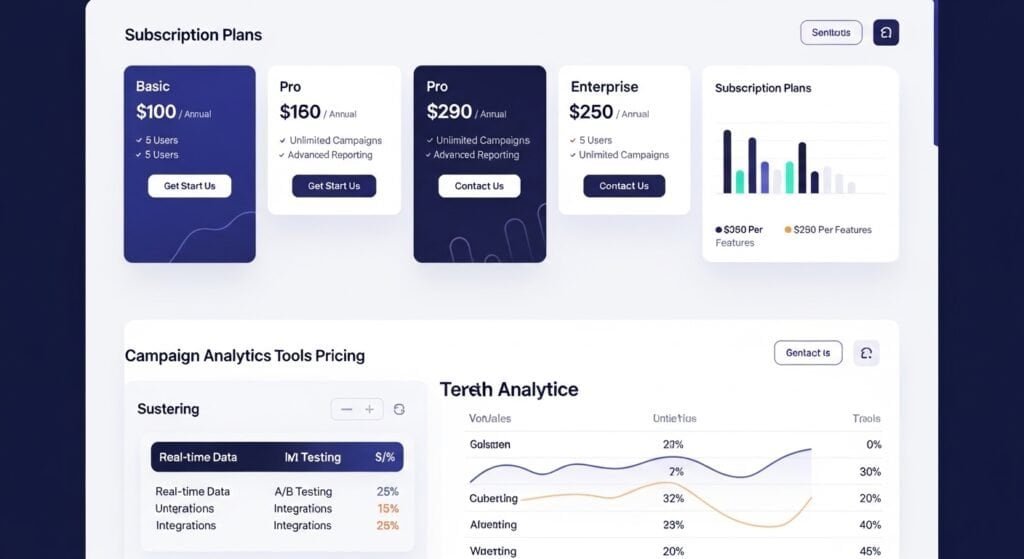
Marketing analytics software pricing varies widely.
Free and entry-level tools
Some tools begin at zero or low monthly cost. These can be useful for early-stage businesses that mainly need traffic visibility and basic dashboarding.
Typical range:
- $0 to $50 per month
Mid-tier analytics platforms
These often include stronger tracking, better reporting, and more flexible integrations.
Typical range:
- $100 to $300 per month
High-end attribution and analytics tools
These tools are more expensive because they focus on more advanced attribution, campaign analysis, and ROI insight.
Typical range:
- $300 to $1000+ per month
The mistake many businesses make is paying for advanced analytics before they have enough volume, complexity, or discipline to use it properly.
Decision Guidance
Choosing the right marketing analytics software comes down to decision logic, not software hype.
Choose based on current complexity
If the business runs simple marketing with one or two channels, a basic stack may be enough.
If it runs multiple funnels, multiple campaigns, and paid traffic with real spend, the analytics stack needs to be stronger.
Choose based on key decisions you need to make
Ask:
- Do I mainly need traffic visibility?
- Do I need better CPL analysis?
- Do I need stronger funnel tracking?
- Do I need clearer ROI measurement?
- Do I need a better dashboard layer?
The answer determines the right category of tool.
Choose based on operational usability
A tool is only valuable if the business actually uses the outputs to make decisions.
Do not buy a platform just because it is powerful. Buy the one that matches the team’s ability to interpret and act on the data.
Choose for the next stage too
The right software should fit the current model while supporting the next stage of growth. If marketing complexity is rising, do not choose a tool that will be outgrown in three months.

Final Recommendation
Marketing becomes expensive when it is not measurable.
Most coaching businesses do not fail because they do no marketing. They fail because they cannot tell which marketing actions are worth continuing. That leads to wasted spend, weak optimization, and slow growth.
AI coaching marketing analytics software matters because it gives structure to marketing decisions. It shows which traffic sources matter, where funnel conversion weakens, how cost per lead behaves, which campaigns generate return, and what should be scaled.
That makes the business more efficient.
It also makes marketing less emotional. Instead of reacting to vanity metrics or surface-level activity, coaches can make decisions using performance data tied to real outcomes.
For a coaching business trying to grow in a disciplined way, that is not optional. It is operational infrastructure.
And that is exactly where marketing analytics software earns its value.
FAQ
1. What is AI coaching marketing analytics software?
AI coaching marketing analytics software tracks campaign performance, funnel conversion rates, cost per lead, traffic sources, and ROI to optimize marketing strategies.
2. How does marketing analytics help coaching businesses grow?
It provides data-driven insights that help identify profitable campaigns, improve conversion rates, and reduce wasted marketing spend.
3. What metrics are tracked in marketing analytics software?
Key metrics include traffic sources, conversion rates, cost per lead, campaign performance, and ROI tracking.
4. Can marketing analytics software improve funnel performance?
Yes. It identifies drop-off points and weak conversion stages, allowing businesses to optimize funnels.
5. Is marketing analytics software necessary for small coaching businesses?
Yes. Even small businesses benefit from understanding which marketing efforts are producing results.
Disclaimer
The information provided in this article is for educational and informational purposes only. While we aim to keep content accurate and up to date, software features and availability may change over time. Some links on this page may be affiliate links, meaning we may earn a commission if you purchase through them at no additional cost to you. Always evaluate tools based on your specific business needs before making a decision.